Behind the label
Understanding Pouch Labels: Units and Ingredient Information
How to read mg per pouch versus mg per gram, and what ingredient labels actually tell you.

Labels may use different measurement bases.
The BfR assessment of nicotine pouch labels discusses two measurement bases: milligrams in each pouch (mg per pouch) and milligrams per gram of product (mg/g). One is an amount per item; the other is a concentration by mass.
Milligrams per pouch describes the amount in one individual pouch. Milligrams per gram describes the concentration in the product by mass. Converting between these requires knowing the mass of a single pouch and whether the measurement refers to the dry or wet content.
mg is the standard abbreviation for milligram.
The BIPM table of SI prefixes defines milli-, symbol m, as one thousandth. One milligram (mg) therefore equals 0.001 grams.
Use the standard lowercase mg in unit explanations. Capitalized artwork lettering does not, by itself, confirm what a product label measures or whether the amount is per pouch or per gram.
Flavor names are not ingredient lists.
A flavor name like "Mint" or "Grape" describes a sensory direction. It does not specify which flavoring compounds, sweeteners, or other ingredients are used to achieve that taste.
An ingredient list, when provided, names the actual substances in the product. The two serve different purposes and should not be confused.
Confirm what substance a number refers to.
A milligram quantity might refer to nicotine, arecoline, a salt form of either substance, or another ingredient. Labels should specify which substance is being measured.
The 10MG shown in the current Snusmeme artwork is a packaging example, not a fixed specification for every product version. The company has confirmed that milligram values can be customized across both series. That statement does not establish particular values, a measurement basis, or a formulation for any version.
For a specific version, approved product documentation still needs to confirm whether the quantity is per pouch or per gram, which substance the number measures, whether it refers to the active substance or a salt form, and the complete ingredient list. The example artwork alone cannot answer these questions.
The number alone does not establish a product's full composition, pouch count, or health risk. Matching flavor names or numbers across the two series do not establish equivalent contents or effects.
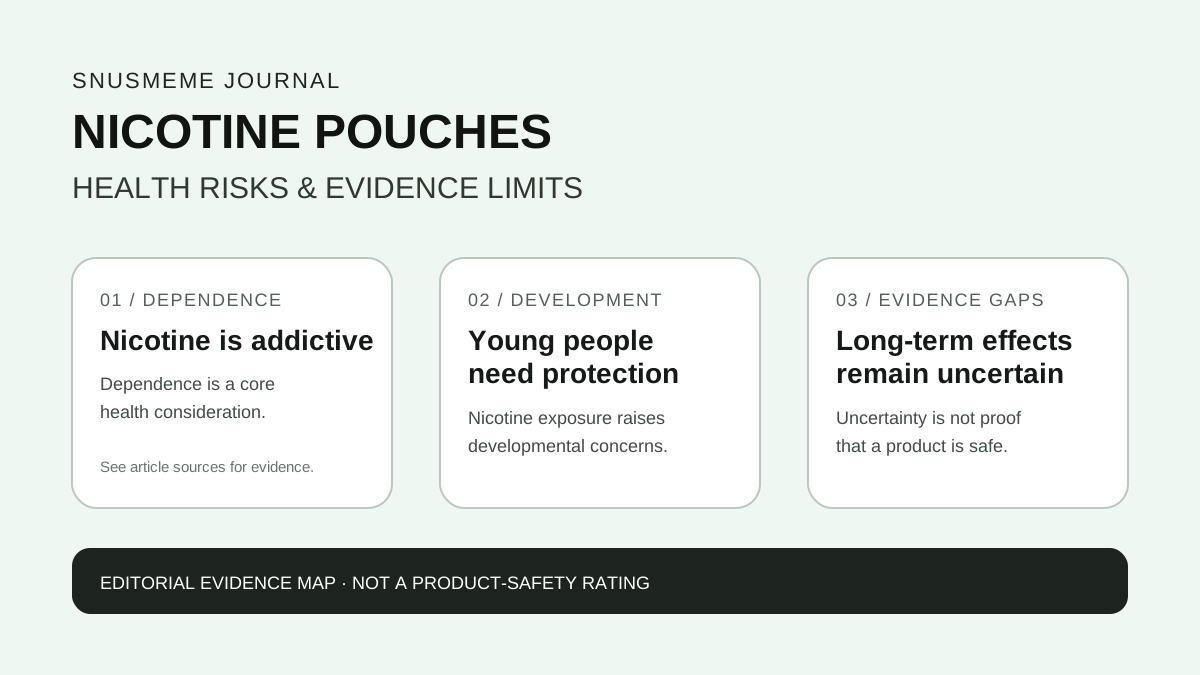
Ingredient evidence also needs to be considered separately. See arecoline evidence and uncertainty and nicotine pouch health risks and evidence limits for the different questions and limitations those substances raise.
Sources and further reading.
- Health Risk Assessment of Nicotine PouchesGerman Federal Institute for Risk Assessment (BfR) · Accessed
- The International System of Units (SI): PrefixesInternational Bureau of Weights and Measures (BIPM) · Accessed